

A follow-up to "N=1 on Omega-6 and Sunburn: Can Sunburn be Reduced?", which I posted on twitter.


Which inspired me to bring this to Dr. Shawn Baker's attention, as he's been running the N=Many carnivory test, which has expanded into some other topics:
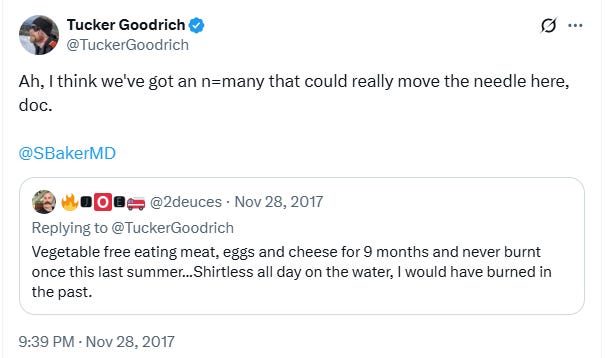
He replied:


I’m not sure about the insulin control part independently, but avoiding seed oils is the way to achieve insulin control.
I got the idea from one of Mark Sisson's Success Stories, many years ago, and thought it was nuts until it happened to me too.
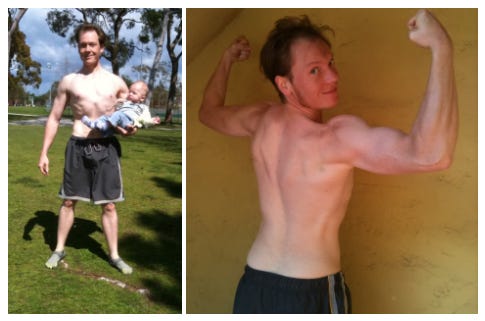

Original post, December 4, 2017
The wife and I ditched seed oils a couple years ago, although we use avocado oil for homemade mayo and ranch dressing, neither of which we consume a lot of. We're not carnivore, but low carb, so I don't know if that's a confounding factor.
My wife is of Scandinavian descent, very light blonde hair, very fair skin, used to burn easily. Now she can spend a couple hours in the pool with no sunscreen and actually tan rather than burn, with no peeling skin.
all the n=1s, my personal anecdote and the cohort and animal studies are enough for me
[ Prospective Cohort Study] Fat intake and risk of skin cancer in US adults (Park et al., 2018)
Finding: Higher omega-6 PUFA intake was associated with increased risk of SCC, BCC, and melanoma in U.S. adults across two large cohort studies (NHS & HPFS).
https://www.ncbi.nlm.nih.gov/pmc/articles/PMC6035072/
[ Mechanistic/Animal Study] Influence of dietary lipid upon ultraviolet light-carcinogenesis . (Black et al., 1992)
Finding: High omega-6 (corn oil) diets promote UV-induced skin cancer in mice, particularly during the promotion stage; switching to low-corn oil after UV exposure reduces tumor burden, while omega-3s show protective effects.
https://onlinelibrary.wiley.com/doi/abs/10.1111/j.1751-1097.1992.tb02147.x
https://pubmed.ncbi.nlm.nih.gov/6520731/4
[ Mechanistic/Animal Study] Dependence of photocarcinogenesis and photoimmunosuppression in the hairless mouse on dietary polyunsaturated fat(Reeve et al., 1996)
Finding: Photocarcinogenesis and photoimmunosuppression worsened with increasing dietary PUFA (sunflower oil) in mice; saturated fat was protective.
https://www.sciencedirect.com/science/article/pii/S0304383596044606
[ Mechanistic/Animal Study] Influence of dietary lipid upon ultraviolet-light carcinogenesis (Black et al., 1983)
Finding: Hydrogenated (saturated) corn oil delayed UV-induced skin cancer onset and reduced tumors vs. unsaturated corn oil; antioxidants had no protective effect.
https://pubmed.ncbi.nlm.nih.gov/6647039/
https://www.tandfonline.com/doi/abs/10.1080/01635588309513780
[ Mechanistic/Animal Study] Dependence of photocarcinogenesis and photoimmunosuppression in the hairless mouse on dietary polyunsaturated fat (Reeve et al., 1996)
Finding: Increasing dietary PUFA (sunflower oil) worsened UV-induced skin cancer and suppressed immune response in mice.
https://pubmed.ncbi.nlm.nih.gov/8973605/
[ Mechanistic/Animal Study] Relation of antioxidants and levels of dietary lipid to epidermal lipid peroxidation and UV-Carcinogenesis (Black et al., 1986)
Finding: Higher levels of dietary unsaturated fats increased UV-induced skin cancer and lipid peroxidation in mice; antioxidants only protective at high fat levels.
https://www.researchgate.net/publication/19098118_Relation_of_antioxidants_and_levels_of_dietary_lipid_to_epidermal_lipid_peroxidation_and_UV-Carcinogenesis